Pages

Showing posts with label what's new. Show all posts

Wednesday, February 19, 2014

New 'Pompeii' movie begs the question: Could Mount Vesuvius erupt again?

A professor of Roman archeology and a volcanologist weigh in on deadly volcanoes, the new film and the surprising evidence that some people may have survived the epic event. 
 
Pompeii
Photo: Sony Pictures

In the summer of 79 A.D., Mount Vesuvius erupted, obliterating the seaside resort of Pompeii. Volcanic ash covered everything, preserving evidence of the disaster for nearly two millennia. The story endures too, in accounts by eyewitness Pliny the Younger, who viewed the eruption from a nearby town, and in books, TV movies and films inspired by the catastrophe.
 
Director Paul W.S. Anderson’s “Pompeii” (opening Feb. 21) is the latest in the genre, focusing on a fictional love story to recount the explosive event, while endeavoring to recreate an ancient world as precisely as possible. His CGI Vesuvius erupts spectacularly, but how accurate is it? Is “Pompeii” true to history? And could this kind of cataclysmic eruption happen again there — or elsewhere on Earth? For answers, we turned to two experts, Sarah K. Yeomans, professor of Roman archeology at West Virginia University, and Dr. Rosaly Lopes, volcanologist and senior research scientist and manager of the Planetary Science Section at the Jet Propulsion Laboratory.
 
Yeomans, who has taken students to Pompeii many times over the last decade, characterizes the ruins there as uniquely “flash frozen in time. When we visit this site we get a real sense of how Romans lived and the things that were important to them. It’s the best insight we have into this ancient culture,” she says, which coupled with a morbid curiosity about devastating disasters, is what makes it so eternally fascinating.
 
“One of the things I really enjoyed was the way Paul Anderson reconstructed the site. He clearly has been there, had done the photography. For example the streets of Pompeii had [raised] stones that people would walk across to avoid mud, sludge and water,” she points out. “The way he reconstructed the houses was really well done, right down to graffiti inscribes on the walls.” The latter was often political or sexual in nature, but the phallic images had a purpose, “what we call an apotropaic function,” Yeomans explains. “They would put images of the phallus next to the doorways. It was a symbol to ward off evil and bad luck. Not all of them did this, but it does account for some of the ubiquity of phallic images.”
 
Visually, Yeomans believes the film “did a nice job with the layout of the city, with respect to where the amphitheater is and respect to other buildings,” and she appreciated its portrayal of the Pompeiian resentment of Rome, which had annexed it 150 years before. But she sees artistic license at play in the depiction of the volcanic eruption. “There was never a lava flow and these firebombs you see launching out of the volcano. That did not happen in this particular type of eruption. But it’s a movie, not a documentary,” she adds.
 
What killed most the population was a combination of heat and ash. “The most deadly phase of the eruption is what’s called a pyroclastic flow — basically super-heated mud that comes racing down at about 80 mph and that kills people pretty much immediately. Most of the people died of heat shock,” says Yeomans. "Nevertheless, there were a few who lived.”
 
“There is plenty of evidence that people did survive. We have inscriptions in other towns that were made by survivors of Pompeii who had relocated. We know that many people left when the earthquakes began. There are tunnels in Pompeii, evidence that people may have come back to tunnel down and retrieve some of their possessions.”
 
Yeomans, who “fell in love with Roman archaeology in my junior year in college” while studying abroad in the Roman ruins-laden region of southern France, says that Pompeii’s ruins are in a vulnerable state due to excavation and tourist traffic, “a pretty large concern at the moment. There have been several recent collapses of houses at the site. They’ve really slowed down on the granting of excavation permits and limit tourist traffic. There’s a great deal of the site that tourists are not allowed access to. The focus is on conserving what’s been excavated.”
 
Will a volcano catch us by surprise?
Also of concern is the possibility, however remote, that Mount Vesuvius — an active volcano — might erupt again. If it did, “It would be equally as dangerous and would affect many more people because now the area is much more populated. We have better technology for evacuation and detection now, though,” Yeomans points out. “Volcanoes are not going to catch us by surprise.” She explains that earthquakes precede volcanic eruptions, “which is what happened with Vesuvius in AD 79. The region is volcanic, and the Romans were used to seismic activity, but there’s no evidence to suggest that they connected the two. They didn’t realize that it was a warning sign of a coming eruption.”
 
According to Lopes, “Vesuvius has not erupted since 1944, and that was not a violent eruption. Not all eruptions of Vesuvius are as violent as the 79 A.D. eruption was; most are not. It could erupt again. The most violent eruptions of Vesuvius tend to occur after the volcano has rested for several hundred years. Vesuvius is very well monitored, so we will have some warning.”
 
Rosaly Lopes in Vanuatu
Dr. Rosaly Lopes in Vanuatu (Photo courtesy NASA/JPL)
 
Globally, “There are many other volcanoes in the world that have the potential to have violent eruptions such as the 79 A.D. one. Mount St. Helens in 1980 was a violent explosive eruption,” she offers as an example. “There are about 600 volcanoes on land considered active, meaning they have been active in historic times and we think they are likely to erupt again. There are many underwater volcanoes along the spreading ridges. As for volcanoes in the U.S., Kilauea erupts often — and it has been active for decades — but not in a violent, explosive way. The most hazardous volcano in the U.S. is considered to be Mount Rainier. This means it could erupt in the near future and has the potential to be very dangerous — it could erupt in an explosive way like St. Helens in 1980. What makes it more dangerous is that it has glaciers at the top, and even a not-very-violent eruption could cause ice to melt, creating mudflows, which are very destructive.”
 
Lopes, who holds a degree in astronomy from the University of London, got into volcanology via a planetary geology course (when the professor missed class to cover a Mount Etna eruption; “I thought that sounded really exciting, and decided that I wanted to do that too.”) She says that in analyzing hazardous volcanoes, modern scientists “look at frequency of eruptions in the past, and how likely one is to happen again in the next few decades.”
 
For example, Yellowstone National Park is a hotbed of volcanic activity. “Yellowstone has had enormous eruptions in the past, it is the largest volcanic caldera on Earth. Calderas are formed by collapse following very violent eruptions. Yellowstone's violent eruptions last occurred hundreds of thousands of years ago. Although its eruptions could potentially be far more devastating than Mount Rainier's, they are less likely to happen in the near future,” she says. Consider yourself reassured. Or forewarned.
 
Sarah K. Yeomans with students at Pompeii. Mount Vesuvius is in the background. (Photo: Alyssa Beall)


http://www.mnn.com/earth-matters/climate-weather/stories/new-pompeii-movie-begs-the-question-could-mount-vesuvius-erupt

Monday, February 17, 2014

Siamese crocodiles released into the wild

Hope for Siamese crocodile conservation as the second group of crocodiles is released into a secret site in southern Cambodia.
After an idle lifetime in the soupy water of a concrete pond, a young Siamese crocodile tests out a new element – the clear flowing water of a jungle river. One of eight individuals, this croclet is part of a test case release project that plans to rewild Cambodia’s rivers with this Critically Endangered species.
Fauna & Flora International (FFI) has been working to conserve Siamese crocodiles in Cambodia since rediscovering a remnant population during a survey of the Cardamom Mountains in 2000. Now numbering fewer than an estimated 300 individuals, the wild population crashed after facing multiple threats. Crocodiles were hunted for their skins, and driven out of former habitats by human encroachment; while young crocs were easily tangled and drowned in fishing nets. But for FFI’s and the Forestry Administration’s intervention, this species was doomed to slip into extinction.
In January this year, the Cambodian Crocodile Conservation Project (CCCP) released the second batch of crocodiles into a secret site in southern Cambodia. The first release in December 2012 saw 18 individuals released, including croclets bred in a specialised facility in Phnom Tamao Wildlife Rescue Centre. The site was specially chosen: a remote forested stretch of prime habitat – somewhere that crocodiles used to live before they were extirpated by hunters and fishermen.
A number of the release crocodiles were fitted with radio tracking devices, enabling the CCCP team to monitor their movements. “Tracking the crocs after release is an essential part of the work, allowing us to see how they are faring, whether they stay in this location, or move on,” said Sarah Brook, FFI Cambodia’s Species Programme Manager.


Radio tagged croc basking among flowers (carnivorous bladderwort) on the riverbank. Credit: Jeremy Holden/FFI
“Five of the original ten transmitters we placed on the crocodiles have now outlived their battery life,” says Sam Han, CCCP Manager, who leads the team that monitor the radio tagged animals. “We are still picking up signals from three of the remaining transmitters, and regularly see other crocs that weren’t tagged. They have moved up and down stream, but return to the original release site and seem to be doing well.”
Siamese crocodile in the soft-release pen. Credit: Jeremy Holden/FFI
Community wardens now visit the location each month to ensure that hunting or fishing doesn’t threaten these new colonists. So far there have been no recorded casualties.
“This project is really a test case to see if the release initiative works,” said Sarah. If it does, we eventually plan to release crocodiles into suitable, well-protected river systems across Cambodia, and truly bring this species back from the brink.
“This will be a long-term prospect, and will require cooperation from zoos and breeders around the world. But if we are successful, we could see the return of one of Cambodia’s most charismatic species – an important part of both Cambodia’s ecosystems and its culture.”


http://www.fauna-flora.org/news/siamese-crocodiles-released-into-the-wild/

Saturday, February 15, 2014

Go Green


tip one  Look for and purchase products that are made from post-consumer content such as paper and plastic products. 

tip two 
 Recycle used office supplies whenever possible. 

tip three 
 Save paper by printing on both sides of a sheet of paper and printing in greyscale/draft whenever possible. 

tip four 
 Turn off your computer when not in use. 

tip five 
 Replace Cathode Ray Tube (CRT) monitors with flat screen monitors. Flat screen displays consume only about one-third the energy of a CRT monitor. 

tip six 
 Keep computer equipment updated; current new computers and monitors are more energy efficient than those even just two years old. 

tip seven 
 Replace standard incandescent bulbs with compact fluorescent lamps (CFLs) wherever possible. These use 75 percent less energy than standard incandescent light bulbs while delivering the same light. 

tip eight 
 Heat or cool your office to 23°C 


http://www.goldengate.com.mt/Content/33/green-office-tips/

Friday, January 24, 2014

Rafflesia Life History


" a penetrating smell more repulsive than any buffalo carcass in an advanced stage of decomposition" (Mjoberg, 1928) There are approximately 17 Rafflesia species distributed throughout Southeast Asia (Nais, 2000; Meijer, 1997; Mat Salleh, 1991). These species are highly specific as to the hosts that they parasitize, preferring only a few species of Tetrastigma (a member of the common grape family) that are distributed in the same geographic area. Although technically a member of the plant kingdom, Rafflesia challenges traditional definitions of what a plant is because they lack chlorophyll and are therefore incapable of photosynthesis (as are all members of its family, Rafflesiaceae).

While many parasites appear like normal plants, Rafflesia lacks any observable leaves, roots, or even stems (Meijer, 1993). Likened to fungi, Rafflesia individuals grow as thread-like strands of tissue completely embedded within and in intimate contact with surrounding host cells from which nutrients and water are obtained (Mat Salleh, 1996). Perhaps the only part of Rafflesia that is identifiable as distinctly plant-like are the flowers; however, even these are bizarre because they attain massive proportions (up to 3 ft in diameter) and are usually reddish-brown and stink of rotting flesh.. Although parasitic, Rafflesia species do not typically kill their hosts in spite of the drain on resources that they cause.
Pollination in Rafflesia has been studied (Beaman et al., 1988) but is likely a rare event due to the several factors. The flowers are unisexual and single sites usually produce either male or female flowers (see exception below). Therefore, in order to have effective pollination (reproduction), male flowers must be in close proximity to, and open at the same time as female flowers so that flies (or any other insect) can transfer pollen.


While male and female individuals could be closely spaced, flower bud mortality is 80-90 % per site thereby reducing the chance of co-flowering of two individuals (Nais, 2000). Furthermore, flower lifespan is only 5-7 days thereby placing a temporal bottleneck on the process of pollination (Beaman et al., 1988; Nais, 2000). To complicate matters further, current population distributions are fragmented due to habitat destruction. Thus, successful sexual reproduction relies on the unlikely event that a male and a female would bloom during the same 5-7 days and that a fly could carry pollen between the often widely separated populations.

Challenges to Studying Rafflesia

There are several reasons Rafflesia has remained difficult to study for the 180 years since its discovery. First, individuals grow entirely embedded within the body of the host plant that they parasitize (Kuijt, 1969). As such, Rafflesia individuals are only visible when they erupt from within the host body as a flower bud. Although traditional means of studying Rafflesia, like anatomical sectioning, could be performed, this method would likely result in death of both the host and parasite. Second, Rafflesia is rare in occurrence and can only be found in relatively remote lowland forests of Southeast Asia. In this region, much of its habitat has been converted to farm land or timber concessions and in some parts of its range, the buds are harvested and sold for their purported medicinal qualities. Third, even once Rafflesia individuals become visible as flowers, these only survive a few days before decomposing. All of these factors make it difficult to even find Rafflesia sites and even when they are known, the sites are often not protected so there is no guarantee that they will exist in subsequent years.

Unlike other parasites that are important to study due to the economic loss they cause to important crops, Rafflesia causes economic benefit through ecotourism: thousands of people go to Sabah (Malaysian, Borneo) annually hoping to see Rafflesia blooms (Nais & Wilcock, 1998).

For this reason, there is great interest in conserving Rafflesia sites rather than eradicating existing populations (as is the case for noxious parasitic plant weeds). Although preserving as much of its habitat as possible would be the simplest and most obvious way to conserve Rafflesia, this is not currently practical throughout its range. Therefore, there is a need to investigate key questions that will establish priorities for ex situ (not natural habitat) propagation (which is only recently possible for the first time in history [Nais & Wilcock, 1999]), management of currently protected sites and procurement of unprotected sites, and in situ (within natural habitat) breeding programs. 
 
http://homepages.wmich.edu/~tbarkman/rafflesia/Rafflesia.html

Monday, January 20, 2014

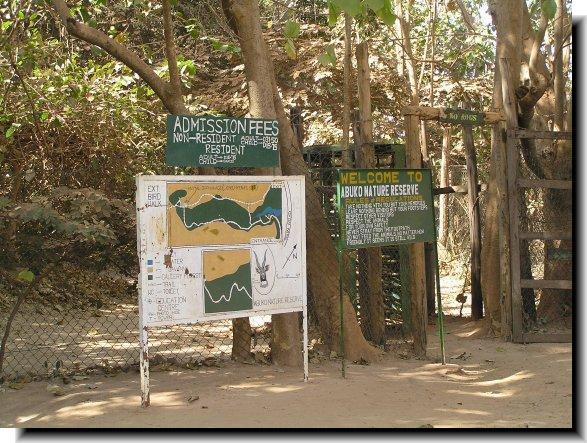
Abuko Nature Reserve

Abuko Nature Reserve, Africa, was the Gambia's first reserve and is located in the Western Region (WR), (geographical coordinates: 13.41°N, 16.65°W). Part of it was accorded a form of 'protected status' back in 1916 when the source of the Lamin (Bolon) Stream was fenced to form a water collection point.

In 1967 a local Gambian man called Kalilu requested the then acting wildlife officer, Eddie Brewer (OBE), to shoot a leopard that had been killing their pigs which had been feeding there illegally. When he visited the spot with his daughter, Stella, they saw an amazing richness of Gambian wildlife and flora and realised the conservation importance of the stream running through Abuko. They made a request to the government to protect it which was promptly approved when it was officially declared a nature reserve in March 1968.

Abuko's size was extended from 188 to 259 acres in 1978 and enclosed in a 2.5 metre fence with the help of the WWF. It is among six protected wildlife management parks and covers an area of 105 hectares (roughly 2 sq. km). The park  is rectangular in shape with a surrounding narrow strip around its boundaries acting as an extra buffer zone. Later in its development 2,000 malina trees were planted to act as an extra barrier against encroachment by locals.

Today, Abuko is the Gambia's most visited tourist attraction receiving approximately 33,000 visitors per year. One interesting fact is that it is the nearest tropical forest to Europe.

Habitats:
The evergreen forest gallery follows the course of the Lamin Stream and covers approximately 1/3 its total area. Efforts are being concentrated on maintaining the crooked bush trails, bird photo hides, the animal orphanage as well as the boundary to prevent encroachment by people and cattle. There are a number of small pools at the bottom end or the reserve with the biggest being called the Bamboo Pool.  In and around the freshwater pond is the ideal location to spot crocodiles and birds.  Its location is within easy reach by taxi from any of the main coastal holiday resorts. It is an ideal first stop for birdwatchers and animal enthusiasts as well as tourist in general. There are designated guides on site to help you locate animals and birds while on the forest trail and a tip is always appreciated though not mandatory.

Park Management:
The conservation of the animals and plants is managed by the Department of Parks and Wildlife Management who are based at the Darwin Field Station for Biodiversity. There main aim is to protect the location and prevent species extinction and helps to fund its activities by charging day trippers an entrance fee.

Flora:
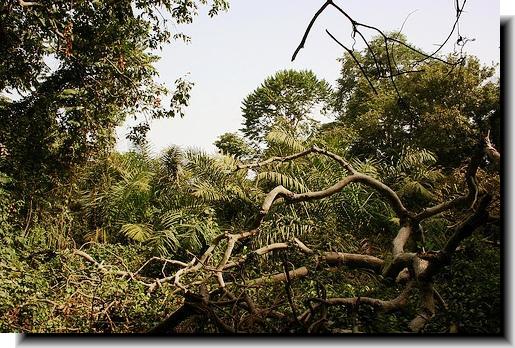
Fifty types of mature tropical trees have been recorded in the protected area. Abuko's main geographic features are several kinds of habitat starting with thick tropical canopy which after 50 to 100m from the stream gives way to Guinean savanna. Probably due to increased borehole water removal the natural habitat has seen the gradual disappearance of mature tropical trees of which the most obvious is the A. Procera and the E. Guineensis. For non experts the trees are labelled.

Avi Fauna:
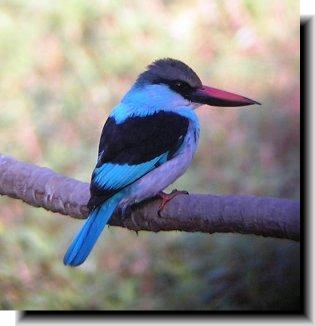
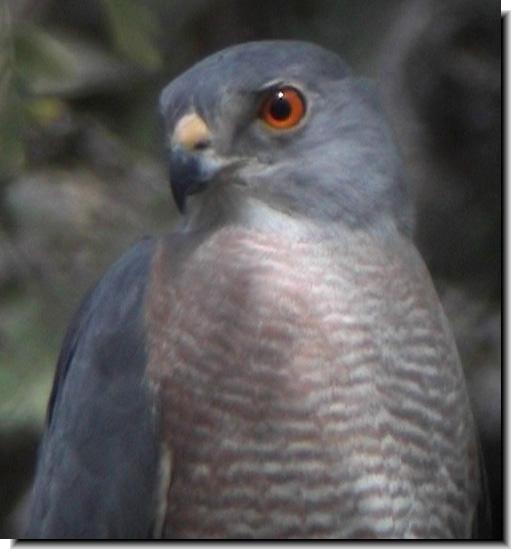
It has been estimated that there are over 290 bird species living within the forest gallery. Among the birds are Pied Kingfishers, African paradise flycatcher, Willow Warblers, waxbills, western bluebill , manikins, doves, lily trotters, giant kingfisher C. maxima, palm nut vultures, hammerkop Scopus umbretta, Ceryle rudis, grey headed bristle bill, white crowned robin chat, grey backed camaroptera, lanner falcon, pygmy kingfisher, violet turacoes, African thrush, fork tailed drongo, black Herons, squacco heron, oriole warbler, Black crake, red bellied fly catchers, little greenbul,  yellow breasted apalis, cattle egrets, Abyssinian roller, purple glossy starling & the Green Touraco.

Fauna:
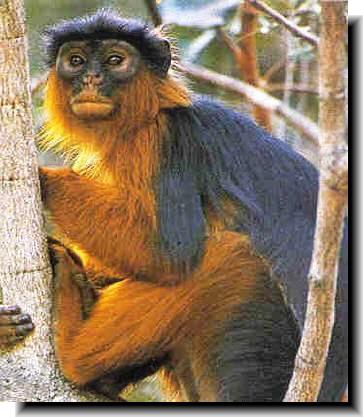
There are 4 primate species: Vervet monkey, Red Colobus monkey, red Patas and Bush Babies. The other mammalian types include the Grimms Duiker, Ground Squirrel, Savannah Antelopes, Bushbuck Colobus badius, Tragelaphus, Brush Tailed Porcupine, Viverra civetta, sitatunga T. spekei, Erythrocebus patas, Mungos gambianus, serval Felis, Heliosciurus gambianus, Thryonomys swinderianus, Galago senegalensis, Actophilornis Africana, Tauraco Persa, Gastropyxis smaragdina Crocodylus niloticus, Xerus erythropus, Cercopithecus aethiops, Palm civet Nandinia binotata and several types of rodent including the Cane Rat.

Threats to the monkeys of The Gambia:
E. D. Starin 1
a1 Department of Anthropology, City University of New York, Graduate Center, 33 West 42nd Street, New York City, NY, USA. Published online by Cambridge University Press 24 Apr 2009.

"Abstract
There are five, perhaps only four, monkey species in The Gambia and all are under threat. The main problems are habitat destruction, hunting of crop raiders and illegal capture for medical research. The information presented here was collected during a long-term study from March 1978 to September 1983 on the socio-ecology of the red colobus monkey in the Abuko Nature Reserve. Further information was collected during brief periods between February 1985 and April 1989 on the presence of monkeys in the forest parks. It is not systematic nor extensive, but it indicates clearly that action is needed if monkeys are to remain as part of the country's wildlife. The most pressing need is for survey work to supply the information needed to work out a conservation plan."
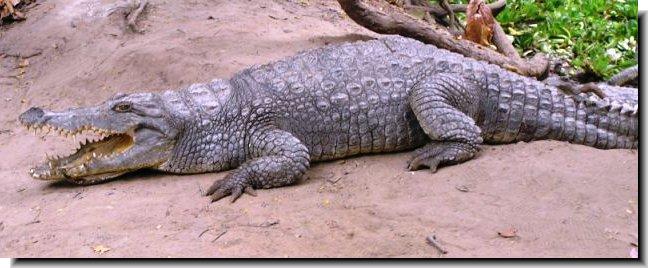
Among the reptiles at the park are the Monitor Lizard, Nile Crocodile, West African crocodile, Dwarf Crocodile, Spitting Cobra, black cobra, python Python sebae, Puff Adders, emerald snake & Green Mamba though it is rare to see.

There are also numerous butterflies and moths such as the Saturnis.

While there you can also visit the Animal Orphanage which was set up in 1997 as a rehabilitation centre by the DPWM. It cares for parrots, hyenas as well as  various kinds of Monkeys including Chimpanzees. Also located on the reserve is the Darwin Field Station which is a research centre focused on maintaining The Gambia's biodiversity. There is also an exhibition, the Abuko Conservation Education Centre and refreshments area which are concentrated around the animal orphanage.

Nature Trail:
Starting your trek you will first come across loose leafed Guinea savanna and you will see trunks covered in mud deposited by tree ants. The trail later drops towards the main Bamboo Pool which is partly covered in water-lilies and fringed by large palms. You will then come across a wooden foot bridge which spans a small swampy stream and goes past the first bird hide and towards the visitor's centre. This building was built in 1970 as a rest house for visitors.

If you make your way up to the observation platform it is possible to get a birds-eye-view of  large lizards, numerous feathered avians and Dwarf or Nile Crocodiles (particularly in the mornings when they come out of the water to sunbath).

From this point you follow the nature trail which leads you to thick, dark, lush vegetation. As you turn left you will see the first glimmering of open bright savanna which is soon interrupted by  more thick jungle which is interspersed at ground level with huge trunks and large root systems. If you look carefully you can see numerous ground squirrels, brightly coloured beetles, vervet monkeys, soldier ants, birds and butterflies. As you continue along the cooked path leading along the southeast you will arrive at an enclosure housing some vultures and hyenas at the Animal Orphanage.

There is a kiosk here where you can enjoy some refreshments. In the next enclosure you can observe Crowned cranes, baboons and bushbuck and next to them you will come across a few lions. From this area there is a path that veers off towards the exit if you are feeling a little tired by this time.

A walk along the trail can take you a couple of hours though there is a short-cut route.

Contacts details:
Department of Parks & Wildlife
Management.
Tel no: +220 4375888
                     4376972
Fax:              4392179
Email: wildlife@gamtel.gm

Travel Information:
If you are not with a tour operator you can pick up a cheap bush taxi from Westfield Junction that is going to Lamin Village on the main Serrekunda to Brikama road and ask to be let off at the front entrance. The best time to visit for birdwatchers is early morning or late afternoon as you can avoid the tourist crowds who tend to come over in the late morning or early afternoon.

Wear thick sturdy boots, use mosquito repellent & bring along some refreshments if you plan to stay long.

An entrance fee is payable. With a tour operator it could cost around D150 for a day trip. If you use a tour operator then the cost could be up to £30 for a full guided tour as well as hotel transfers. Refreshments are available should you wish to spend the day there.


http://www.accessgambia.com/information/abuko-nature-reserve.html

Wednesday, January 15, 2014

Flora and Fauna

The famous Divi Divi tree is Aruba's natural compass, always pointing in a southwesterly direction due to the trade winds that blow across the island from the north-east.
Aruba's trademark: the Divi Divi or watapana tree


An interesting observation is that attempts to plant this tree in other parts of the world have proved futile - it seems the Divi Divi is most comfortable in Aruba!

Aruba's dry climate is home to large Mondis (forests of cacti)

Despite its arid climate, Aruba has a large array of horticulture. One example is the Magdalena, similar in foliage and flower to the Impatiens found in the Eastern US, but which survive with very little water. Their purple and white flowers blossom all year round, providing natural decoration both along sidewalks and roadsides and also in the most looked-after gardens.

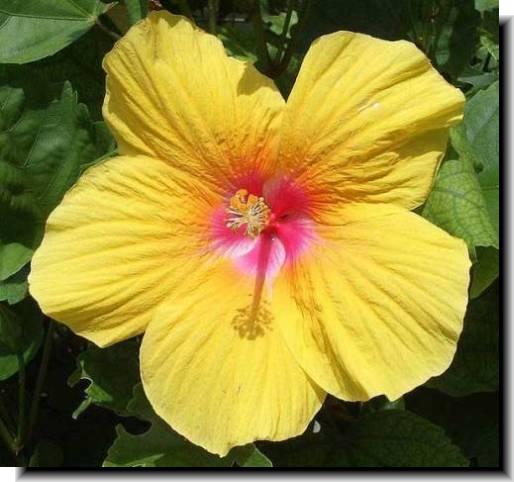
Also widespread are Caribbean Pines, a large variety of Hibiscus as well as Bougainvilleas, Wild Orchids and many other cacti, vines, shrubs and trees.

Lizards (Papiamento - lagadishi) abound in Aruba. In fact, half of the species of lizard known to man reside exclusively on the island. The kododo blauw (left) has a blue-green color, are quite friendly and totally vegetarian. Pega Pega are cousins to the gecko and get their papiamento name (pega means to stick) ,from the tiny suction pads on their feet which allow them to walk practically anywhere.
They are one of the last remaining prehistoric species who have eluded extinction - and have extremely loud voices. Iguanas (right), looking like miniature dinosaurs are often found high up on rooftops enjoying the sun or in trees where they find their favorite food - leaves.

Unfortunately they were often considered a delicacy themselves (their meat is tasty, comparable to chicken) and have been used in soup and stew by Arubans for generations. This practice is now illegal.

Iguanas adapt to their surroundings in much the same way as chameleons do, changing color from bright green to a more brownish hue when they're on the soil.
The Cottontail rabbit is also found in Aruba, and was probably brought over here originally by Indians prior to Columbus' time. A clue which seems to substantiate this theory is the fact that the rabbits here have a black patch on their necks, similar to those found in nearby Venezuela.

Although once thought to be disappearing, wild donkeys are making a comeback and are usually seen in groups of three or four in the more rugged parts of the island. For more information: www.arubandonkey.org Brought to the island by the Spanish, these donkeys were often a test of manhood for many youngsters from San Nicolas who would try to mount and ride them.
Some time ago, hotels in Aruba specifically put gratings outside their entrances to deter sheep and goats from entering their gardens. These animals are quite common on the island, and goats also find their way to the Aruban table where they are also considered a tasty dish.
A common sight on many of Aruba's beaches are pelicans. For more information on birds of Aruba: www.arubabirds.com These zealous fish eating birds can often be seen swooping down and diving into the sea, disappearing underwater for a few seconds while they home in on their targets.
Bats can be found in caves towards the Northeast of the island - most are insect eaters and nectar drinkers with the exception of one particular species that prefer fish and dive into the sea for their food.


http://www.visitaruba.com/tours-and-activities/flora-and-fauna/